Targeted inheritance of sex improves animal breeding
Targeted inheritance of sex improves animal breeding
A new study from Bernhard Herrmann’s group shows how targeted, non-Mendelian inheritance could solve problems in livestock breeding.
November 24, 2025
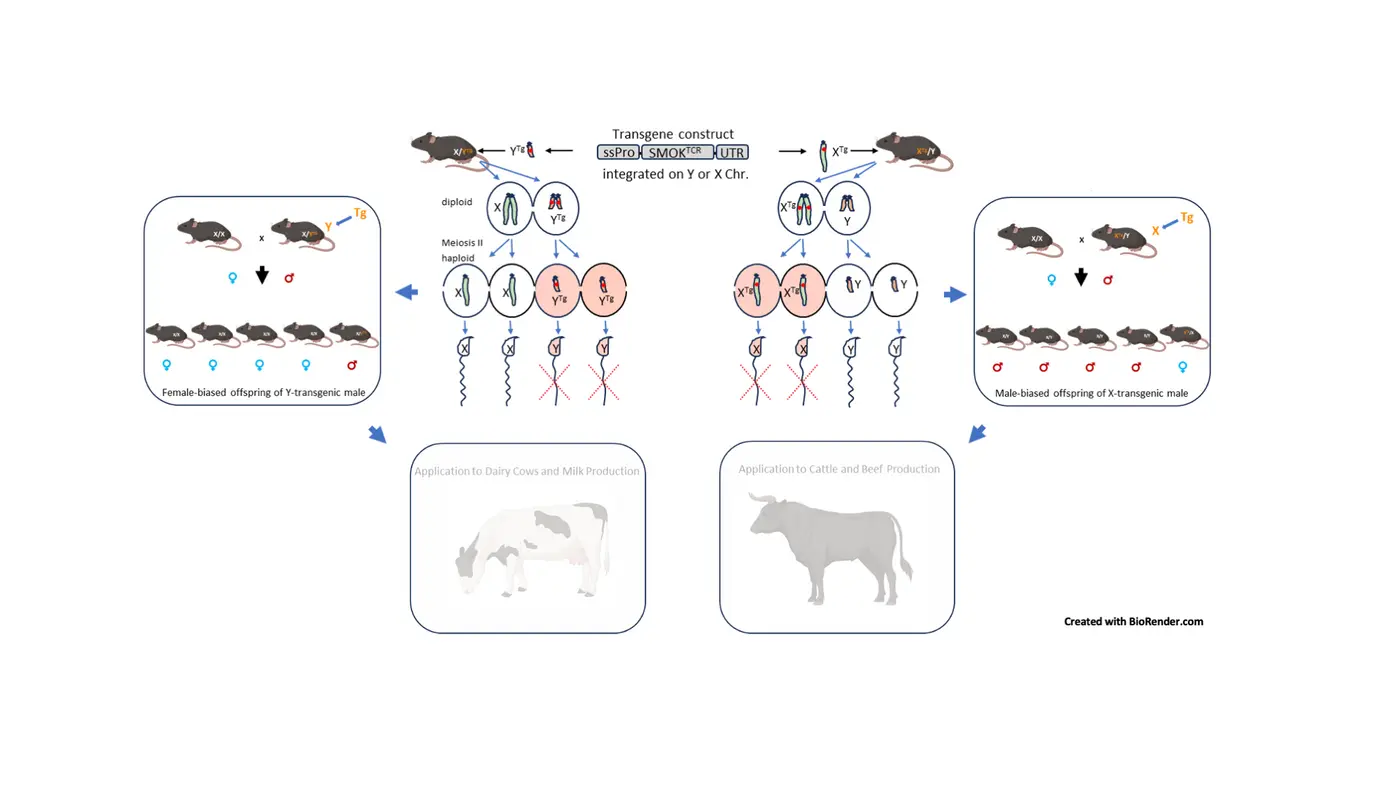
One of the fundamental rules of inheritance states that different alleles (gene copies) of a trait, such as sex, are inherited with equal frequency. “However, we have long known that there are genes that can increase their rate of inheritance,” explains Bernhard Herrmann. His laboratory at the MPIMG has been studying one such element for some time – a section on chromosome 17 in mice called the t-haplotype. In earlier work, the researchers elucidated this factor genetically and molecularly. In their current study, published in the journal Genetics, they now show how the t-haplotype can be used to influence the inheritance of sex chromosomes in mice. This approach to preferentially passing on desired genetic traits could, among other things, help make livestock breeding more efficient and animal-friendly.
Unfair competitive advantage
The effects of the t-haplotype only become apparent during egg-cell fertilization. However, sperm are specially prepared for this process during development. In the first phase of development, the t-haplotype produces several “disruptive factors” that are distributed to all cells. These factors later prevent the sperm from moving forward efficiently. In the second phase, the chromosomes separate. As a result, half of the sperm receive the t-haplotype, while the other half do not. “The t-haplotype has a trick up its sleeve to gain a competitive advantage: it produces an antidote called Smok-Tcr that counteracts the disruptive factors, but only in cells containing the t-haplotype,” explains Herrmann. The resulting t-sperm are more motile and therefore better able to fertilize eggs.
Phenomenon can influence the sex of offspring
However, Smok-Tcr activity alone – without any interfering factors – also impairs the motility of the sperm carrying the gene. The scientists took advantage of this phenomenon by inserting Smok-Tcr elements specifically into the X or Y chromosomes. “We have, so to speak, reversed the approach here and are using Smok-Tcr to inhibit the inheritance of the unwanted sex chromosome while promoting that of the desired one. If the element is located on the Y chromosome, sperm that produce female offspring have a clear advantage – and vice versa,” said Hermann Bauer, the study’s first author. “We were able to further enhance the effect through targeted sequence improvements. For example, if this optimized Smok-Tcr is located on the Y chromosome, almost 90% of the offspring are female.” This method offers a clear advantage over previous attempts to influence sex inheritance.
Use in animal breeding
In addition to mice, this method could also be applied to other livestock mammals, such as cattle. Depending on whether the focus is on milk or meat production, one sex is often preferred. Young animals that are not needed are often killed. “The culling of unwanted animals is problematic both economically and in terms of animal ethics. Our method offers a solution to this problem,” says Bernhard Herrmann. Other experimental approaches to influencing sex can negatively affect the health and fertility of animals and their offspring. In contrast, the researchers’ method has no adverse health effects on the animals. “The desired offspring for meat or milk production would not be genetically modified,” concludes Hermann Bauer.
access the original article from https://www.molgen.mpg.de/2025-11-25-targeted-inheritance-of-sex-improves-animal-breeding?c=228720
Related Posts

Celebrating Farmer Field Schools (FFS) across Africa
At GreenGold AgroVentures, March (The planting Month) is a time to spotlight one of the most transfo...
Read More →
MY SEEDS, MY FOOD, MY FUTURE - Reclaiming the Foundations of Food Systems in Africa
At GreenGold AgroVenture, we believe that the future of food begins with the seed. The simple yet po...
Read More →